Showing posts with label Puppy Tips. Show all posts

Take your dog out for run!

Bring dog out for jogging
Bringing a dog walking is a daily activity you must do. This is useful for you and your dog to be healthy. It also brings you and your dog closer. The first thing to remember is to check the dog's veterinary medicine before. This is particularly important if your dog is overweight or old. The second thing you need to know is to wait until he is older than one year before taking it out for a walk or run. 


The next thing is to make sure your dog's breed (if they breed dogs who like to walk or run) as well as genetic and physical features. Last but not least, you need to know is to never indulge just before or after feeding.

Before you begin, prepare a collar and leash. Make sure the collar fit, not tight and not too loose. Do not forget to bring a bottle of water for you and your dog to drink. Choose a safe route and not busy with road traffic and road surface is not rough. Most importantly, make walking and running fun activities! Do not put pressure on him and do not make it too tired.


What you need to do when bringing out your dog:

1 You must be a person outside the door first, followed by your dog. This also applies when you return home. Let the dog into the house before you. This will show your dog that you are the leader.

2 Bring your support at the beginning when your dog / puppy first learned how he was on-leash. If the dog does not know what to do, show it. Walk slowly and let the dog lead you first. After a while, you can lead the dog instead.

3 Walking with the same speed. Not too slow or too fast.

4 Do not let your dog leave your side. If the dog is in front of you, stop moving altogether and wait for the dog to stop as well. Walk side by side with one another.

5 Do not let your dog roam / sniffing each object / chase something / etc that will distract your dog from walking (or running).


What you need to do when a dog ran:

1 You need to start running program slowly. You really have to start with a walk, even if your dog is energetic. Start bringing your dog to walk long distances.

2 After a week or more, combine the activities of walking with running. If your dog from behind, slow down. Reduce the continued activities of walking and running-added activities within approximately a week to week until the dog he used to run.

3 Rest your dog for a day after one day of running.


Overheat dog
When walking or running, check signs of trouble that can mean dehydration, stroke, overheating, and fatigue. Immediately stop and take the medicine veterinarian if your dog excessive panting, foaming at the mouth, seizures, sudden stops and weakness in the limbs. Another thing you need to do while walking or running is to ensure that if your dog defecate in the middle of the road, you must clean it up! When you finish walking or running, check the soles of your dog's feet to see if any cuts or abrasions. Do not forget to give praise and give the dog treats if the dog walk or run activities properly.

How to save your dog from poisoining?

Curious dog
Dogs are curious creatures and want to investigate and this is one of the triggers a lot of cases of poisoning. Poisons can enter the body in 3 ways: through the skin (usually liquid), by inhaled (gas), or by eating (solid or liquid) which is the most common problems. It is your responsibility as dog owners to keep all dangerous products tightly closed and out of the reach of your dog.

Some signs of poisoning that may occur are excessive salivation, vomiting, diarrhea, abdominal pain, twitching, nervousness, convulsions, coma, and the smell of chemicals in the body (if your dog seizures, loss of consciousness, or has trouble breathing, immediately take medicine or the local animal emergency clinic immediately.) Below are haly you can do before the dog was taken for further examination and treatment.

If your dog is exposed to toxic fluids through his skin, hair clippers that have been contaminated with these fluids. The next step is to wash the contaminated area with dog shampoo or baby shampoo, then rinse thoroughly. Wear gloves to avoid toxic fluids.

If your dog inhaling poisonous gases, remove the dog from the area and take it to the fresh air and open immediately. Flush the eyes of dogs with saline solution or clean water. If the dog is not breathing, feel the heartbeat by placing your fingers about 2 inches behind the dog's elbow, the middle chest. If the heart is not beating, perform CPR. If the dog is still breathing, perform artificial respiration.

If your dog to swallow liquids or food hazardous / toxic, give the dog hydrogen peroxide to induce vomiting. Making the dog vomit will eliminate some toxins that have been entered into the body and you will gain time until he was treated by a veterinarian. To make your dog vomit, get your dog's head back and spray of hydrogen peroxide towards the back of his tongue. If he does not vomit after 10 minutes, try again. Do not give more than two doses of hydrogen peroxide! Also, do not use the product over-the-counter use by humans.

Help your dog from poisoning soon!
Do not induce vomiting if your dog has eaten caustic chemicals such as cleaning fluids because the poison will cause a burning sensation when passing throat. Immediately wash the mouth and face with water and then give the dog something to neutralize the chemicals, such as 3 teaspoons vinegar / lemon juice diluted in the same amount of water or milk.

After poisoning, every minute is very meaningful. If the dog passed out it means poison has reacted and you have to take him to the vet immediately. It is also important to have to get medical help even if your dog does not look sick. Dogs that poisoning may appear normal for several hours or even days after the incident.

How to choose the best dog carrier for your dog

Dog carrier
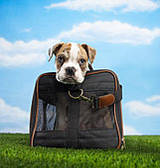
A dog carrier offers a convenient way to transport the puppy or your adult dog. Dog carrier will still provide security for your dog and also you as the owner. When choosing a dog carrier there are important things that need to be considered first. After that all are met, you can find the appropriate style and personal taste. There are several styles, materials and size of dog carrier you can choose, some suitable only for small breed dogs only, while others can accommodate any size dog.

The things you want in the dog carrier is: durable, easy to clean, easy to use, can be used for air or sea travel, lightweight and stable. Your dog carrier also must have a mechanism for secure closure and lots of air holes or windows. Your dog carrier should make your dog feel safe and comfortable. Of course, a dog carrier that attractive and can be changed as you wish it had its own added value. The size of your dog carrier dog should match the size of your dog. Last but nonetheless important is the dog carrier must have a clear warranty.

To help you choose the perfect dog carrier for your dog, consider the following factors:

1. Determine what the main purpose of dog carrier

If you would often bring your dog, lightweight carrier that is the most fitting choice. If the carrier will be more frequently used at home, you should choose a carrier that is more heavy and bulky. If a dog carrier will be used for air or sea travel, you need to use a solid plastic carrier with wire door, depending on the airline regulations. If you have a small dog, you might want to carriers which looks more like a handbag so you can carry your dog everywhere.

2. Consider the size of your dog

Dog carriers come in various shapes and sizes. Most dog carrier will include height and weight type of dog that would be appropriate for the carrier. It is recommended that the dog carrier has enough room for the dog stand up and roll over without difficulty and felt cramped.
  •  Dog carriers for small dogs
Small dog carrier
If you have a breed of small dog, the dog-shaped carrier bag most suitable for use. These types of dog carriers like the bag was taken as usual. Some models allow you to strapped into car seats, making travel by car is safer for your dog. Another common type is the dog carrier in the form of backpacks. You can use a dog backpack carrier for dogs which is slightly larger and some models can be converted into car seat for a dog. There is also another option called a sling. It has features that are associated shoulder strap, storage pouch, and the bottom is soft and comfortable. It's made of sturdy nylon fabric and can accommodate dogs weighing up to 10 kg.
  • Dog carriers for big dogs
Big dog carrier
For larger dogs, you have three choices: a portable crate, plastic crate, and crate wire. They used not to carry but to transport your dog by car / plane / ship. Portable Crate is made of soft material and can accommodate a dog whose size is too big for the duffel bag or backpack. Some of the commercially available portable crate had a handle. Because of very light, and when folded does not meet the place, portable crate is easy to use while traveling.

Plastic crate similar to a portable crate, only they are made of hard plastic. They come in various sizes and not like other dog carrier, plastic crate can be used to transport a dog on the plane because it met the flight rules for pet travel domestically and internationally.

A wire crate is not really defined as a carrier in the sense you carry it, but rather the means to carry or move the dog in the journey by car. This provides security not only for your dog, but also for the drive. Crate wire offers visibility and better ventilation, it is much easier to clean, and more durable when compared with the two previous crate.

3. Check the carrier material made of what

Dog carrier material
Carrier made of various materials ranging from plastic, mesh, metal or a soft cloth. If your dog likes to chew, you may be better to buy a carrier that is made of metal or plastic rather than soft cloth or net. If your dog handle the situation better if can not see around it, the carrier made from solid plastic or solid fabric to choose from. Carrier that easy to clean is  made from plastic and metal. A carrier made of fabric may need to be washed with soap or rinse with a hose when dirty. There are certain dog carrier made of a kind of cardboard paper and is much more sturdy and durable than plastic. If the carrier is to be wet so they can easily be destroyed or damaged. It is advisable for you to not use a carrier that is made from this material.

4. Check the design and quality

Design and quality of dog carrier


5. Think about your dog's comfort

If your dog screaming, shaking and trying to jump out of the carrier you choose, he may need a little help from you to know that the carrier makes the trip more enjoyable and safe. Teach your dog that the carrier is a safe place. Start by placing treats in the carrier and allow him to jump into the bag to retrieve treats. Place it gently on the carrier. With whom he talked and joked each time you put into the carrier. Take time beforehand to familiarize the dog in the carrier before taking it by using the carrier road.

How to choose the best breed for you and family

Choosing a dog
Choosing the right dog for you or your family can be tough. Finding the right dog is very important to develop a healthy relationship with your dog. Some dog breeds will naturally be more suited to the lifestyle, needs and desires. It is also important to consider whether you can meet the needs of dogs. Particular dog and / or certain dog breeds require care, attention or affection more than other dogs.


1. Decide what you need from a dog

Do you need a dog to accompany you or security? Male dogs are usually more aggressive than female dogs. A larger dog would take more space in your place as compared with a smaller dog. Knowing what you want from the dog so you will not regret it later.

2. Consider your home state

Dogs with high activity levels require more space than a dog that is not too active. Perform research dog breeds that you want to see how much space is needed. If you are interested in the dog mixed race, parents know the history of these dogs.

3. Understand the family situation and lifestyle that you have

Pets are not objects and therefore only requires certain things to live a productive, healthy and happy. Do you have small children who would disturb a dog or injured by a dog? Do you have other pets? Do you live in a big house with a backyard, or a small apartment on the fourth floor? Aware of the state of the house you have.

4. Estimating how much attention you can give

Some dog breeds require more attention to be a happy dog. If you are a person who is very busy with work or activities, you should reconsider getting a dog. All dogs need attention and exercise. You need to make sure that you are willing and happy to take care of these animals all his life.

5. Consider how much patience you have for the dog

Some breeds are easier to be trained than any others for that you need to know everywhere are more easily trained if you are not among those who wait.

6. Do research about which dog breed you desire

Each breed has its own history and there is no reason why a dog has its own distinctive character. Understanding why a dog breed will help you to find a dog with good temperament and agility that you want.

7. Calculate your financial resources

Large dogs require more food than small dogs and this means you need more money allocated to the expenditure on their food. Dogs with thick hair need grooming more than a few feathers. All dogs will tend to be bothered by illness at some point in their lives but certain breeds are more prone to suffer from the disease.

How to bathe a puppy

Bathe a puppy
Finally it was time for the puppy be bathed for the first time. Do not bathe the puppy younger than 8 weeks. For puppies under 8 weeks, simply rinse with plain water and wipe dog and do not use anti-lice shampoo. If the puppy is more than 8 weeks old, you can bathe the puppy with a special shampoo gentle dog. Always use a shampoo for dogs and should be bought in pet shops. If you choose to use anti-lice shampoo on the puppy, you really have to wait until he was at least 3 months.


To make the puppy get used to bathing, you must to start slowly. Be sure to make it fun, you can offer him treats or toys. Here are step by step tips :
  1. Take the puppy to use a bath tub or other place that you will use when a child is an adult dog. 
  2. After the puppy used to being in the bath (or other bathing places), started to wipe him with wet towels when he was still there. Remember to offer treats or toys when you do this.
  3. After the puppy used to the wet towel, prepare a small container which was filled with water. Pour water slowly into the body puppy. Get used to be a wet puppy.
  4. After he's used to this, you can use the water flow. This procedure may take time compared to bath time experience, so be patient to continue to perform this procedure until the puppy is ready for a real bath.

Eventually, your puppy is ready for a real bath. You'll need a dog shampoo, towel, comb, bucket or hose, a soft toothbrush, and dog treat / toy. 
  1. Prepare the area for the bath and make sure it's clean. Next, collect the items. Take all the necessary items (shampoo, towels, hoses, etc.) and then take your puppy.
  2. After that, wet puppy. Do not use water that is too hot or too cold, warm water is best for him. Both use a spray nozzle or a bucket, always start from the body and then moved to the head, trying to not over water in their ears. When you use a spray nozzle, make sure that the gentle spray of water.
  3. After he was wet, you can now start shampooing. Rub the shampoo with reversed direction from the direction of hair growth and do not scrub too hard. Rub ranging from body to head for about 10-15 minutes. To clean the face, you can use a damp cloth.
  4. To clean the feet, you can use a soft toothbrush. There must be no bubbles in the eye or ear puppy. The next step is to rinse thoroughly. Make sure you make his head up so that soapy water does not enter into his eyes.
  5. You must keep bathing his body with water until you can run your hand over their coats and did not see the rest of the shampoo out. If you do not rinse it completely, it can cause skin dryness and irritation.
  6. The final step is to dry. Wrap them in a towel so the towel can absorb excess water. Then begin massaging gently drying them with his body. If you decide to use a hair dryer, make sure the puppy has been accustomed to the sound before you try to use it on himself. Be sure to keep the heat at low temperature and keep a distance of about 40-45 cm from puppy.
As a rule, you should not bathe the puppy more than once a month. With increasing age of the dog, you can increase the frequency of baths to twice a month. Do not bathe the puppy unless he is dirty or very smelly. Too much bathing can remove protective oils from the coat and it makes the coat look dull. If the exposed of mud on puppy, you can clean it using a towel with soap and warm water. If the puppy smells, you can gently rub the dog's coat with a dog wipe or baby wipe.